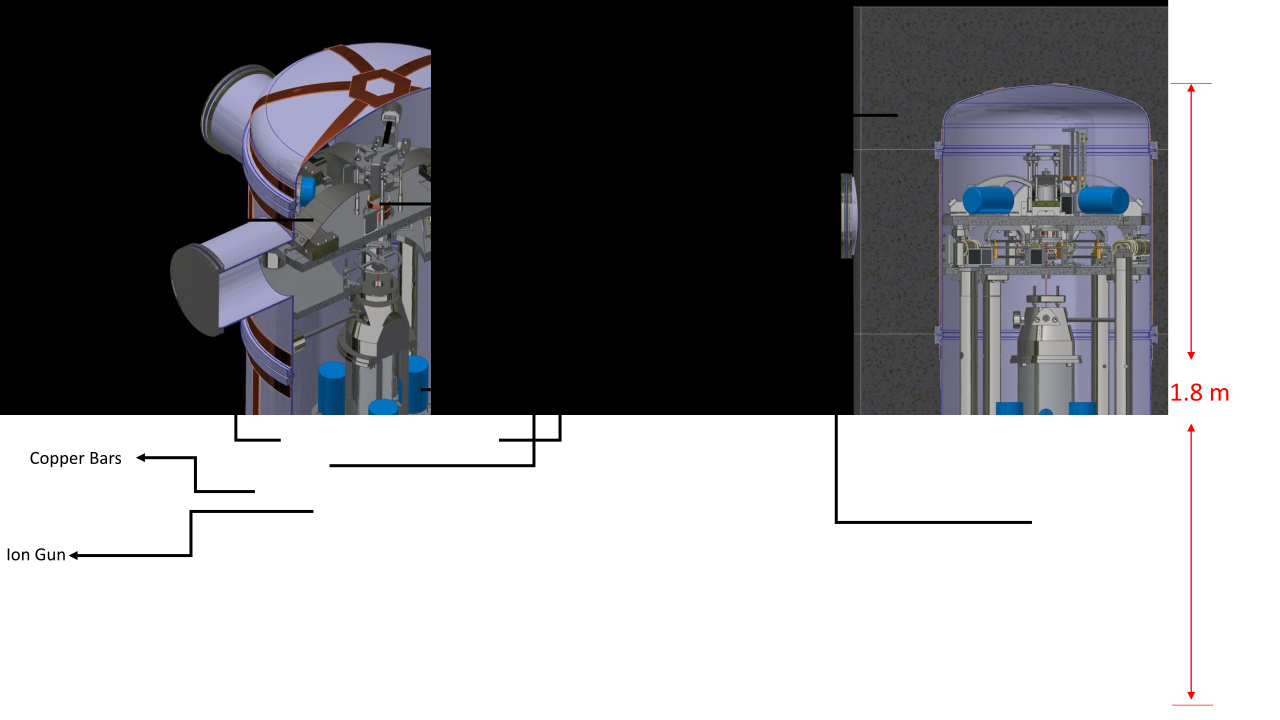
Instrument Architecture
The CANNEX platform nests a silica reference plate beneath a silicon single-crystal force sensor inside a 1.8 m ultra-high-vacuum stack. Three 200 µm-range piezo translators trim plate parallelism and separation while fiber-coupled interferometers and an optical cavity deliver sub-nanometer readout over the 1 cm2 aperture.[1] The sensor and shroud assembly rides on a drift-free stick-slip positioning cage that supports both interfacial and shielded Cavendish configurations, maximizing plane-parallel overlap for interfacial, gravitation-like, and screened forces.
Sensor Stack and Readout
Optical fibers polished flush with the lower plate rim provide three-beam interferometric control of tilt and cavity length, while a central fiber interrogates the silicon sensor displacement. An automated stick-slip micropositioner maintains micron-scale cavity tuning, and interferometer data stream into Kalman-filtered state observers to stabilise the sensor bias over long integration times.[1], [4]
Thermal and Vacuum Architecture
The inner core operates at <10−9 mbar using an ion-getter pump while guided copper heat exchangers route waste heat to the outer chamber without adding mechanical coupling. Non-contact thermal shrouds and Peltier stages hold gradients below the microkelvin level, whereas UV/argon ion cleaning ports mitigate electrostatic patches before each run.[1], [2]
Seismic Attenuation System
The suspended core couples to an external isolation stack combining an inverted pendulum (horizontal), a geometric anti-spring (vertical), and a tuned mass tower (tilt) to suppress ground motion below 100 mHz.[1], [3] Magic-wand extensions on the GAS blades further damp residual resonances, while co-located geophones and linear variable differential transformers feed a real-time observer loop that maintains micro-radian alignment.[4]
Operating Configurations and Calibration
Three operating modes address complementary systematics. The interfacial configuration maximizes plate overlap for Casimir and short-range gravity searches; the Cavendish configuration introduces a gold-coated electrostatic shield for differential gravity-like measurements; and a Kelvin probe mode characterises surface work-function patches across each plate to constrain electrostatic backgrounds.[1], [2]
Science Program and Outlook
With its stabilized plane-parallel cavity, CANNEX targets thermal Casimir physics beyond the proximity-force approximation, tests screened chameleon and dilaton fields, and constrains environment-dependent scalar interactions over tens of microns.[1], [5], [7] The isolation stack and modular vacuum design also provide a platform for future upgrades, including cryogenic operation and resonant sensing campaigns proposed in the collaboration roadmap.[6]
Key References
- H. Haghmoradi et al., “Force Metrology with Plane Parallel Plates: Final Design Review and Outlook,” Physics 6, 45 (2024). https://doi.org/10.3390/physics6020045.
- W.J. Kim et al., “Surface Contact Potential Patches and Casimir Force Measurements,” Phys. Rev. A 81, 022505 (2010). https://doi.org/10.1103/PhysRevA.81.022505.
- A. Stochino et al., “Improvement of the Seismic Noise Attenuation Performance of the Monolithic Geometric Anti-Spring Filters for Gravitational Wave Interferometric Detectors,” Nucl. Instrum. Meth. A 580, 1559–1564 (2007). https://doi.org/10.1016/j.nima.2007.05.210.
- M.G. Beker et al., “State Observers and Kalman Filtering for High Performance Vibration Isolation Systems,” Rev. Sci. Instrum. 85, 034501 (2014). https://doi.org/10.1063/1.4868485.
- R.I.P. Sedmik, “Casimir and Non-Newtonian Force Experiment (CANNEX): Review, Status, and Outlook,” Int. J. Mod. Phys. A 35, 2040008 (2020). https://doi.org/10.1142/S0217751X20400088.
- R.I.P. Sedmik et al., “Status Report and First Light from CANNEX: Casimir Force Measurements between Flat Parallel Plates,” Universe 7, 234 (2021). https://doi.org/10.3390/universe7070234.
- P. Brax et al., “Tuning the Mass of Chameleon Fields in Casimir Force Experiments,” Phys. Rev. Lett. 104, 241101 (2010). https://doi.org/10.1103/PhysRevLett.104.241101.